Wednesday, October 15, 2025

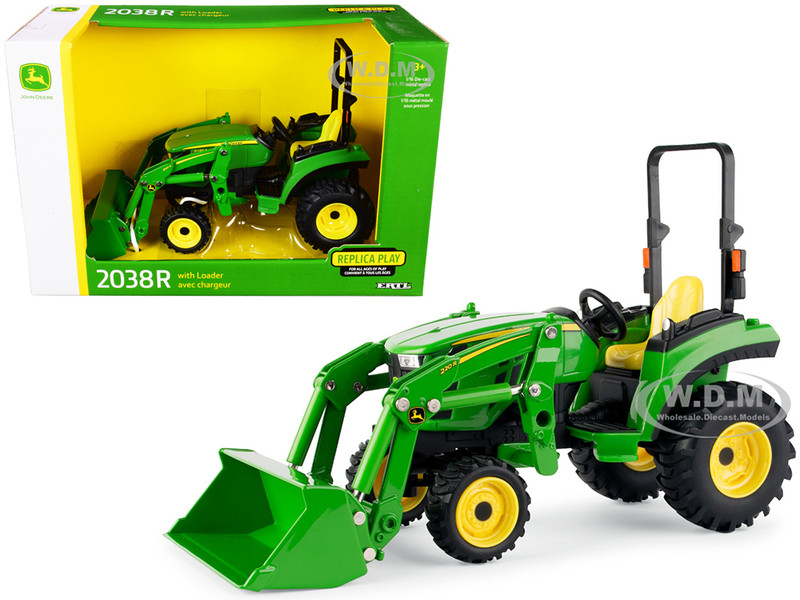
John Deere 2038R Tractor with Loader — 1/16 Diecast Model by ERTL TOMY Full in-depth review


Overview
The ERTL TOMY 1/16 scale diecast John Deere 2038R with loader is one of those models that sits perfectly between toy and collectible. It captures the compact, purposeful look of the real 2038R tractor while remaining sturdy enough for handling and light play. If you like realistic small-farm machines on your shelf or want a rugged play model for a kid who loves tractors, this piece aims to satisfy both audiences.

First impressions and packaging
The package presentation is simple and classic: windowed blister or boxed window depending on the retail run, with clear branding and imagery that showcases the model without excessive frills. The model arrives securely fastened, usually with twist ties or molded plastic supports that protect painted surfaces and small parts. Right out of the box the vivid John Deere green and yellow contrast looks authentic — not overly glossy, not dull — and the loader is already attached and usable. The packaging makes the model feel like a premium toy while keeping it affordable.

Build quality and materials
ERTL/TOMY’s reputation for diecast construction shows here. The main chassis and several body panels are heavy enough to feel realistic in hand; key structural parts are diecast metal while fine-detail components (mirrors, small levers, lights, operator seat, loader bucket) are injection-molded plastic. This combination delivers good durability — it won’t shatter if dropped from shelf height — while allowing for delicate details that casting alone can’t reproduce.

Paint, decals and realism
The paint job is crisp and true to John Deere’s livery. Masking between green bodywork and yellow wheels is clean, and the factory-applied decals (model numbers, JD logo, hazard stripes where applicable) are well-placed and aligned. Close-up inspection reveals sharp edges on decals and fine printing on instrument panels and grille elements. Weathering is intentionally absent — it’s a “new tractor” look — which is appropriate for display collectors and also keeps the model attractive to younger owners.

Detailing and scale fidelity
On a 1/16 model scale, the level of fidelity is impressive. The hood shape, exhaust, roll-over protection structure (ROPS), and loader geometry echo the real machine’s compact proportions. The cab interior is simplified but recognizable: seat, steering wheel, and basic console are present. Mirrors, front lights, and rear linkage components are included and proportioned well. For modelers who like to upgrade, the model provides sensible attachment points for aftermarket bits or light custom weathering.

Loader and moving parts
The front loader is the highlight for playability. It articulates smoothly through its intended range — lift, lower, and tilt motions — and the bucket holds small loads (gravel, pretend hay, etc.) without dropping them immediately. Movement is generally resistant enough to hold poses for display, yet loose enough for a child to manipulate. Hydraulic lines and loader arms are represented with molded detail rather than flexible hoses; they look good and are robust, but they are not built for heavy-duty rough play.

Wheels, tires and undercarriage
The tires have molded tread and a slightly rubberized feel on many runs, lending grip and a realistic look. The wheel hubs show the signature John Deere yellow and have molded lug details. The undercarriage isn’t heavily detailed but avoids awkward blank spaces; essential elements like the differential and chassis framing are hinted at well enough for the scale.

Functional features and accessories
Commonly this model ships with a removable front loader and sometimes a rear hitch or basic implement compatibility. It’s not usually a multi-implement system with snap-on attachments in every release, but the loader itself is sturdy and functional. There’s enough realism in the hitch and linkage to allow connection with other 1/16 compatible implements if you already own them, or to inspire a small diorama build.

Durability and play suitability
This model sits in the sweet spot for hybrid use. It’s solid enough to survive handling by children and light outdoor play, but detailed enough to please collectors who will display it on a shelf. Small fragile parts like exterior mirrors can be vulnerable to overly rough play; buyers should be mindful if it’s for very young kids. Overall, it balances detail with toughness better than many pure display models.

Collector value and presentation
For collectors, the model’s strengths are faithful livery, clean decals, and accurate silhouette. It looks great in a farm scene or as part of a John Deere collection. If you want museum-quality micro-detailing or aftermarket-accurate hydraulics, there are higher-end scale models for those needs, but those typically cost much more. The ERTL TOMY 1/16 2038R often represents an excellent value-for-money collectible: attractive, durable, and true to brand identity.

Pros
• Strong visual accuracy: correct proportions and recognizable styling.
• Solid diecast construction: pleasing weight and durability.
Functional loader with smooth articulation for play and display.
• Clean paint and decals that match John Deere branding.
• Good balance between collectible detail and play robustness.

Cons
• Small molded plastic parts (mirrors, lights) can be fragile under very rough play.
• Interior and undercarriage details are simplified compared with premium scale models.
• Not every retail run includes interchangeable implements or extra accessories.

Who should buy this
John Deere brand fans who want an attractive, shelf-ready model without spending on premium collectibles.
• Parents or gift buyers looking for a durable, realistic tractor toy for children who enjoy farm play.
• Modelers and diorama builders who want a solid base model to weather, modify, or pair with 1/16 implements.
• Collectors on a budget who want consistent livery and good build quality.

Care and display tips
Keep the model away from prolonged direct sunlight to prevent paint and plastic fading. Dust with a soft brush or microfiber cloth to avoid scratching decals. If used in play, check fragile parts occasionally (mirrors, loader pins) and tighten gently if the model uses small screws. For display, a small base or low-profile stand helps present the loader in a raised position without stressing the loader pins.

Overall verdict
The ERTL TOMY 1/16 John Deere 2038R with loader hits an excellent middle ground: it’s attractive enough for collectors, robust enough for children, and honest in its representation of the real machine. It won’t replace the ultra-detailed, high-end museum models, nor is it intended to. Instead, it offers a satisfying combination of realism, functionality, and value that makes it a standout choice for anyone who likes well-made farm machinery models. If you want a faithful little John Deere that you can both display and handle, this one is a very strong candidate.

🚜Get The John Deere 2038R On Diecastmodelswholesale🚜

Thursday, October 9, 2025

Under Siege: My Family’s Fight to Save Our Nation — A Comprehensive Review


When Under Siege: My Family’s Fight to Save Our Nation is released on October 14, 2025, it will mark Eric Trump’s first full-length memoir, with a foreword by Donald J. Trump. The book promises to deliver an unvarnished, intimate perspective on life behind the headlines of one of America’s most controversial dynasties. Below is a full, in-depth examination of what the book sets out to achieve, where it shines, where it falls short, and what its broader implications may be.


Overview and Premise

From the publisher and promotional materials, Under Siege positions itself as more than just a family memoir: it frames itself as a political declaration of resistance. Eric Trump claims that over the years, his family has been systematically targeted by what he calls “lawfare,” partisan court maneuvers, media bias, and even assassination attempts. He pledges to recount never-before-shared details: the onslaught of subpoenas and depositions, gag orders, the FBI raid on Mar-a-Lago, attempts to seize assets, two impeachments, and campaigns to deplatform and delegitimize the Trump name.

In his narrative, Eric presents himself both as a protector of the Trump legacy and a frontline soldier for a movement he regards as existential for America. He interweaves personal recollections—childhood, family dinners, business negotiations—with policy battles, legal fights, and ideological warfare.

Eric also states that a portion of the proceeds from the book will be donated to Turning Point USA, a political youth organization. He references his personal relationship with its founder, Charlie Kirk, and frames the donation as part of his commitment to the broader conservative cause.


Structure and Content

The book spans roughly 288 pages and is divided into chapters that map onto three overlapping arenas of Trump life: family, business, and politics. The early chapters ground the reader in the Trump family’s inner workings: the dynamics among siblings, the influence of their father, and how the Trump brand was built and maintained. There’s also material about Eric’s role in The Celebrity Apprentice, his ascent within the Trump Organization, and how he assumed greater responsibility over time.

From there, the narrative shifts to the political and legal maelstrom that has surrounded Donald Trump and his family. Eric devotes large space to describing subpoena battles, court cases, alleged bias in the justice system, and repeated attempts (in his telling) to dismantle their enterprises or silence their voices. He claims that every legal and political assault on the Trump family is also an assault on the future of conservative America.

Throughout, the memoir is punctuated with vignettes—some dramatic, some personal—that aim to humanize the Trump family in contrast to their public image. The book attempts to blend memoir, political argument, and defense of family legacy.


Strengths

Insider Access & Personal Storytelling

One of the book’s most compelling elements is its access. As a son deeply involved in both the business and political arms of the Trump enterprise, Eric is well positioned to tell stories that outsiders could not. The glimpses into private conversations, boardroom struggles, and behind-the-scenes maneuvers give the narrative a lived, immediate quality.

Emotional Stakes

Eric often presents himself not merely as a spokesman but as someone with skin in the game—someone who felt attacked, stretched, and under constant pressure. That personal tone lends urgency: this is not just a distant political treatise, but a story of family survival, relational strain, and the cost of public life. For readers sympathetic to the Trump cause, those emotional beats may land strongly.

Narrative Framing

The framing of the book—even its title—positions the Trumps as defenders of the nation rather than merely political actors. That frames the story in grand, even existential terms. For its intended audience, this grand narrative will be powerful. Eric does not shy from bold claims, and that flair gives the book a clear voice of conviction.

Strategic and Political Observations

Because Eric bridges business and politics, he occasionally offers sharp insights into campaign strategy, media relations, legal strategy, and how institutions respond under pressure. Those sections may appeal to readers interested in political operations, conservative media, or the mechanics of modern American power.


Weaknesses and Critiques

Imbalance and Selectivity

One of the most obvious challenges in a memoir of this kind is selectivity. Eric’s perspective is necessarily self-protective. The events he recounts tend to favor interpretations that show him and his family as victims of conspiracies or unjust systems. Critics will argue that his portrayal often lacks engagement with counter-evidence or adversarial voices. Major omissions or alternative interpretations likely remain unaddressed.

Echo Chamber Appeal

Because the book is written for and largely by those within the pro-Trump ecosystem, parts of it may function more as a rallying manifesto than a nuanced reflection. Readers outside that base may find the tone one-sided or polemical rather than open to persuasion. Some chapters may read less like exploration and more like argumentation.

Repetition & Rhetorical Excess

Given the density of legal battles, media narratives, and political conflicts in Trumpian life, the memoir is vulnerable to redundancy. Scenes of subpoenas, press attacks, and courtroom skirmishes can repeat in structure and tone. Also, the narrative style sometimes tilts toward hyperbole—describing each conflict as apocalyptic or existential—which may fatigue readers not already attuned to that rhetorical scale.

Fact vs. Narrative

Because much of the book deals with legal and political disputes, the tension between memory, interpretation, and verifiable fact is challenging. Readers looking for rigorous accountability, footnotes, or external corroboration may find the memoir’s claims lean heavily on persuasion rather than documentation. In controversial domains—charges of corruption, misconduct, or institutional bias—some readers will demand external validation that the book does not always provide.

Variable Depth

Some of the more compelling chapters—family dynamics, internal business decisions, or emotional crises—are detailed and vivid. But the sections that delve into legal or institutional complexities at times skim over technical or procedural detail in favor of narrative momentum. Readers with deep knowledge of law, politics, or Trump-era controversies may find those parts relatively shallow or hand-waved.


Style, Tone, and Voice

Eric’s voice in Under Siege is unapologetic, combative, and candid (within his frame). He writes with urgency and often with a sense of weathered confidence. While the tone is partisan, there is also a visible aim to humanize and protect his family’s image. The prose is accessible and avoids heavy theoretical or academic language; instead, it emphasizes storytelling, conflict, and emotional stakes.

Where the book is strongest is in moments of vulnerability—here was a family, under pressure, trying to hold itself together. But that vulnerability is often followed by counterattack, framing, rebuttal. The book is structurally defensive: it wants to anticipate critiques and defang them in advance.

Because of that, the narrative sometimes feels like a written press release or a legal defense in book form, rather than a wholly open, reflective autobiography. Yet, for its target audience, that may be a feature, not a flaw.


What Readers Will Gain — and What They May Question

For supporters or sympathetic readers, Under Siege offers a powerful narrative: a behind-the-scenes defense of a political family, a call to recognize the supposed assaults on conservative institutions, and an emotional portrait of resilience under pressure. It gives allies more language, more stories, and more fuel.

For curious onlookers, the value lies in those insider glimpses: how the family interacts privately, how the Trump Organization balances business and politics, how legal and media pressures ripple through personal life. Even readers critical of the Trumps may find the memoir illuminating as a primary source for how the Trump inner circle sees itself.

But critics will raise many questions: Where are the checks on selective memory? Where is accountability for decisions made at the center of power? When claims are made of bias or conspiracy, how does one assess them independently? The absence of footnotes, or heavy reliance on narrative over documentation, will give skeptics room to contest many assertions.

Moreover, the book’s framing of almost every challenge as external assault leaves little space for introspection about internal missteps, strategic errors, or ideological blind spots.


Broader Implications and Cultural Role

Under Siege is not just a memoir; it is a cultural artifact of its moment. Its timing (after multiple legal combats, indictments, and political polarization) ensures it will be engaged in public debate. It will likely become part of the arsenal for political operatives, media commentators, and engaged citizens to frame the Trump legacy going forward.

Because Eric donates a portion of the proceeds to a conservative youth organization, the book is also a fund-raising and mobilization tool. The choice ties the personal memoir to broader ideological project, blurring lines between autobiography and activism.

In years to come, Under Siege may also serve as a reference point: how did insiders portray the Trump legal era, and how might future historians frame those claims against public record, court documents, and investigative reporting? In that way, the memoir’s importance may grow less in its immediate persuasiveness and more as a witness to how one faction of American politics understood its own struggle.


Final Assessment

Under Siege: My Family’s Fight to Save Our Nation is likely to succeed beautifully for its intended audience—those who already view the Trump family as beleaguered defenders of a conservative cause. Its strength lies in insider storytelling, emotional urgency, and a combative but personal voice. For that readership, it delivers validation, narrative fuel, and a clearer picture of how one of its own sees the battle lines.

However, for more critical or skeptical readers, the book will not easily bridge ideological divides. Its selectivity, rhetorical posture, and lack of external accounting will leave many unanswered questions. As a political autobiography, it is more rallying cry and defense than balanced reflection.

In sum, Under Siege is an ambitious entry in the genre of political memoir. It will not convert skeptics easily, but for those who share its premises, it offers a rich, deeply personal window into the Trump world and its worldview. As both narrative and artifact, it is destined to play a prominent role in the continuing debates over legacy, power, and the shape of American conservatism.

🕮Get Eric Trump's Under Siege On Amazon🕮

What to expect on eBay for Black Friday

eBay has already begun prepping its “Black Friday” destination page, announcing a wide array of categories—electronics, fashion, home ...