Overview
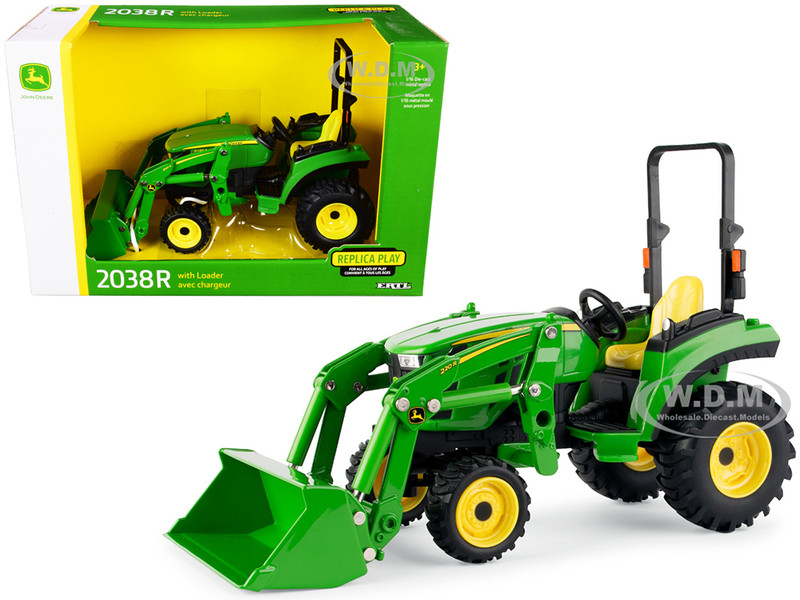
The ERTL TOMY 1/16 scale diecast John Deere 2038R with loader is one of those models that sits perfectly between toy and collectible. It captures the compact, purposeful look of the real 2038R tractor while remaining sturdy enough for handling and light play. If you like realistic small-farm machines on your shelf or want a rugged play model for a kid who loves tractors, this piece aims to satisfy both audiences.
First impressions and packaging
The package presentation is simple and classic: windowed blister or boxed window depending on the retail run, with clear branding and imagery that showcases the model without excessive frills. The model arrives securely fastened, usually with twist ties or molded plastic supports that protect painted surfaces and small parts. Right out of the box the vivid John Deere green and yellow contrast looks authentic — not overly glossy, not dull — and the loader is already attached and usable. The packaging makes the model feel like a premium toy while keeping it affordable.
Build quality and materials
ERTL/TOMY’s reputation for diecast construction shows here. The main chassis and several body panels are heavy enough to feel realistic in hand; key structural parts are diecast metal while fine-detail components (mirrors, small levers, lights, operator seat, loader bucket) are injection-molded plastic. This combination delivers good durability — it won’t shatter if dropped from shelf height — while allowing for delicate details that casting alone can’t reproduce.
Paint, decals and realism
The paint job is crisp and true to John Deere’s livery. Masking between green bodywork and yellow wheels is clean, and the factory-applied decals (model numbers, JD logo, hazard stripes where applicable) are well-placed and aligned. Close-up inspection reveals sharp edges on decals and fine printing on instrument panels and grille elements. Weathering is intentionally absent — it’s a “new tractor” look — which is appropriate for display collectors and also keeps the model attractive to younger owners.
Detailing and scale fidelity
On a 1/16 model scale, the level of fidelity is impressive. The hood shape, exhaust, roll-over protection structure (ROPS), and loader geometry echo the real machine’s compact proportions. The cab interior is simplified but recognizable: seat, steering wheel, and basic console are present. Mirrors, front lights, and rear linkage components are included and proportioned well. For modelers who like to upgrade, the model provides sensible attachment points for aftermarket bits or light custom weathering.
Loader and moving parts
The front loader is the highlight for playability. It articulates smoothly through its intended range — lift, lower, and tilt motions — and the bucket holds small loads (gravel, pretend hay, etc.) without dropping them immediately. Movement is generally resistant enough to hold poses for display, yet loose enough for a child to manipulate. Hydraulic lines and loader arms are represented with molded detail rather than flexible hoses; they look good and are robust, but they are not built for heavy-duty rough play.
Wheels, tires and undercarriage
The tires have molded tread and a slightly rubberized feel on many runs, lending grip and a realistic look. The wheel hubs show the signature John Deere yellow and have molded lug details. The undercarriage isn’t heavily detailed but avoids awkward blank spaces; essential elements like the differential and chassis framing are hinted at well enough for the scale.
Functional features and accessories
Commonly this model ships with a removable front loader and sometimes a rear hitch or basic implement compatibility. It’s not usually a multi-implement system with snap-on attachments in every release, but the loader itself is sturdy and functional. There’s enough realism in the hitch and linkage to allow connection with other 1/16 compatible implements if you already own them, or to inspire a small diorama build.
Durability and play suitability
This model sits in the sweet spot for hybrid use. It’s solid enough to survive handling by children and light outdoor play, but detailed enough to please collectors who will display it on a shelf. Small fragile parts like exterior mirrors can be vulnerable to overly rough play; buyers should be mindful if it’s for very young kids. Overall, it balances detail with toughness better than many pure display models.
Collector value and presentation
For collectors, the model’s strengths are faithful livery, clean decals, and accurate silhouette. It looks great in a farm scene or as part of a John Deere collection. If you want museum-quality micro-detailing or aftermarket-accurate hydraulics, there are higher-end scale models for those needs, but those typically cost much more. The ERTL TOMY 1/16 2038R often represents an excellent value-for-money collectible: attractive, durable, and true to brand identity.
Pros
• Strong visual accuracy: correct proportions and recognizable styling.
• Solid diecast construction: pleasing weight and durability.
• Functional loader with smooth articulation for play and display.
• Clean paint and decals that match John Deere branding.
• Good balance between collectible detail and play robustness.
Cons
• Small molded plastic parts (mirrors, lights) can be fragile under very rough play.
• Interior and undercarriage details are simplified compared with premium scale models.
• Not every retail run includes interchangeable implements or extra accessories.
Who should buy this
• John Deere brand fans who want an attractive, shelf-ready model without spending on premium collectibles.
• Parents or gift buyers looking for a durable, realistic tractor toy for children who enjoy farm play.
• Modelers and diorama builders who want a solid base model to weather, modify, or pair with 1/16 implements.
• Collectors on a budget who want consistent livery and good build quality.
Care and display tips
Keep the model away from prolonged direct sunlight to prevent paint and plastic fading. Dust with a soft brush or microfiber cloth to avoid scratching decals. If used in play, check fragile parts occasionally (mirrors, loader pins) and tighten gently if the model uses small screws. For display, a small base or low-profile stand helps present the loader in a raised position without stressing the loader pins.
Overall verdict
The ERTL TOMY 1/16 John Deere 2038R with loader hits an excellent middle ground: it’s attractive enough for collectors, robust enough for children, and honest in its representation of the real machine. It won’t replace the ultra-detailed, high-end museum models, nor is it intended to. Instead, it offers a satisfying combination of realism, functionality, and value that makes it a standout choice for anyone who likes well-made farm machinery models. If you want a faithful little John Deere that you can both display and handle, this one is a very strong candidate.