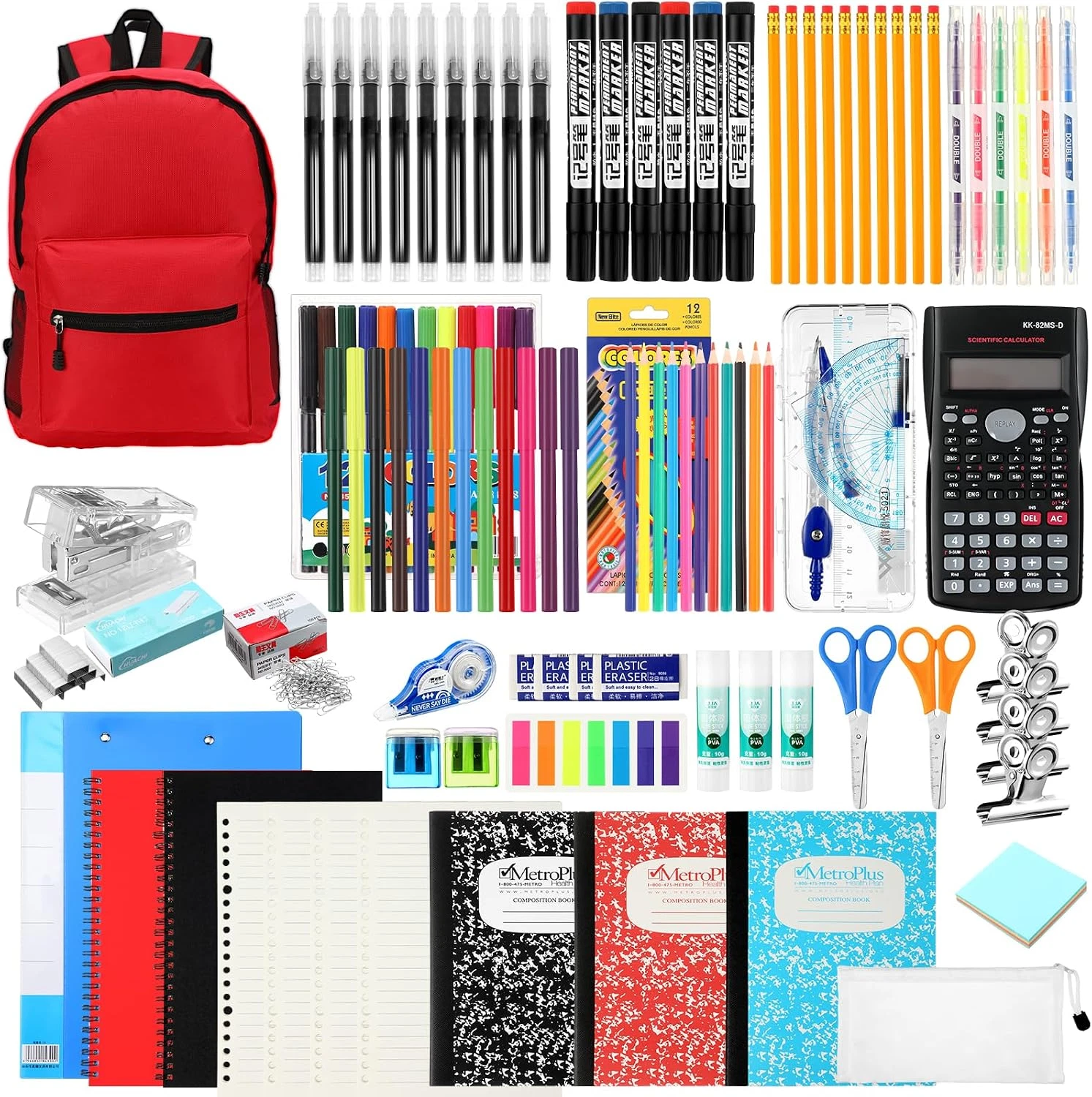
Back-to-school shopping can be one of the most expensive and time-consuming parts of preparing for a new school year. Parents often spend hours visiting multiple stores to collect everything from notebooks and folders to pencils, glue sticks, scissors, and backpacks. Products like the 81-Piece School Supply Kit with Backpack aim to simplify that process by packaging nearly everything a student needs into one convenient bundle.
This kit is marketed as a complete school supply solution for elementary, middle school, and even high school students. It includes an assortment of classroom essentials along with a backpack, allowing families to purchase nearly everything in a single package.
After examining its features and customer feedback, here's a detailed look at what this bundle offers and whether it provides good value.
First Impressions
The biggest selling point of this kit is convenience.
Instead of purchasing dozens of individual school supplies, buyers receive a complete collection already packaged together. For busy parents, teachers purchasing classroom materials, charitable organizations, or anyone donating school supplies, this saves both time and effort.
The kit typically includes:
- Backpack
- Spiral notebooks
- Folders
- Pencils
- Pens
- Erasers
- Glue sticks
- Scissors
- Crayons
- Colored pencils
- Highlighters
- Pencil sharpener
- Ruler
- Additional classroom essentials
While exact contents may vary slightly depending on the seller, the bundle is designed to cover most standard school supply lists.
Backpack Quality
The included backpack is perhaps the most debated part of the package.
Advantages
The backpack provides enough room for everyday school essentials and offers several compartments for organization. It is lightweight and suitable for carrying basic classroom supplies.
For younger elementary students or light daily use, the backpack performs adequately.
Drawbacks
Many customer reviews note that the backpack is not particularly heavy-duty.
Common complaints include:
- Thin fabric
- Lightweight stitching
- Smaller-than-expected size
- Limited durability under heavy loads
Students carrying multiple textbooks every day—especially middle or high school students—may eventually need a more durable backpack. Several buyers reported that the backpack wore out quickly under regular use.
School Supplies Included
The actual supplies make up the majority of the value.
The assortment covers most everyday classroom needs including writing, organizing, and basic art projects.
Items generally include:
- Writing pencils
- Ink pens
- Colored pencils
- Crayons
- Glue sticks
- Folders
- Spiral notebooks
- Loose paper
- Scissors
- Ruler
- Erasers
- Pencil sharpener
Having everything organized inside one package is a significant advantage, especially during busy shopping seasons.
Rather than wondering whether an item has been forgotten, parents receive nearly everything at once.
Organization Benefits
One overlooked advantage is how organized the kit arrives.
Everything is packaged together instead of spread across multiple shopping bags.
This makes:
- Back-to-school preparation easier
- Classroom donations simpler
- Emergency school shopping less stressful
Many buyers appreciated not having to hunt through crowded stores searching for individual supplies.
Suitability by Grade Level
Elementary School
This is where the bundle performs best.
Most elementary students require basic supplies rather than specialty materials, making this kit an excellent match.
For younger students, the backpack size is generally appropriate, and the included supplies closely match typical classroom requirements.
Middle School
Middle school results are more mixed.
Students who carry fewer textbooks may find the backpack acceptable.
However, those transporting heavier materials every day may need something sturdier.
High School
This is where the product receives the most criticism.
Although marketed toward high school students, many reviewers felt the notebooks, folders, and backpack were undersized for older students' needs.
Several parents ended up replacing portions of the kit after purchase.
Build Quality
The quality of the individual supplies is generally acceptable for everyday classroom use.
Most items perform their intended purpose adequately.
However, this should be viewed as a value-oriented bundle rather than a premium collection of school supplies.
Some customers describe the materials as budget-grade, while others felt they represented fair value considering the large number of included items.
Value for Money
The biggest strength of this kit is its overall value.
Purchasing 81 individual items separately can quickly become expensive.
By combining everything into one package, buyers often save both money and shopping time.
The convenience factor alone makes this attractive for:
- Parents with multiple children
- Teachers
- Non-profit organizations
- School donation drives
- Community outreach programs
Even if a few items eventually need upgrading, the kit still covers the majority of basic classroom needs.
Who Should Buy It?
This bundle is an excellent option for:
- Elementary school students
- Families looking for affordable school supplies
- Parents wanting one-stop shopping
- Teachers purchasing classroom extras
- Churches and charities donating supplies
- Organizations assembling back-to-school kits
Who Might Want Something Else?
This may not be the best choice for:
- High school students carrying heavy textbooks
- Students needing premium-quality supplies
- Buyers expecting a heavy-duty backpack
- Those requiring brand-name school supplies
Pros
- Complete all-in-one school supply bundle
- Eliminates multiple shopping trips
- Includes backpack and classroom essentials
- Good value for the quantity included
- Convenient for donation programs
- Suitable for most elementary school supply lists
- Helps simplify back-to-school preparation
Cons
- Backpack durability is below average
- Some supplies are smaller than expected
- Less suitable for older students
- Budget-grade materials throughout
- Some families may still need to purchase additional supplies
Final Verdict
The 81-Piece School Supply Kit with Backpack succeeds in its primary goal: making back-to-school shopping faster, easier, and more affordable. Its greatest strengths are convenience and value, offering a broad assortment of everyday school essentials in one package.
The biggest compromise is quality. While the included supplies are generally functional, the backpack and some accessories are built to meet a budget price point rather than provide long-term durability. This is especially noticeable for middle and high school students who carry heavier loads throughout the school year.
For elementary students, classroom donations, or families looking for an inexpensive all-in-one solution, this kit represents solid value. Buyers seeking premium supplies or a backpack that can withstand years of heavy daily use may want to invest in higher-quality alternatives.
Overall Rating: 4 out of 5 stars
This bundle delivers excellent convenience and a comprehensive collection of school essentials at an affordable price, making it a practical choice for younger students and budget-conscious families, even if a few components may eventually need upgrading.


